
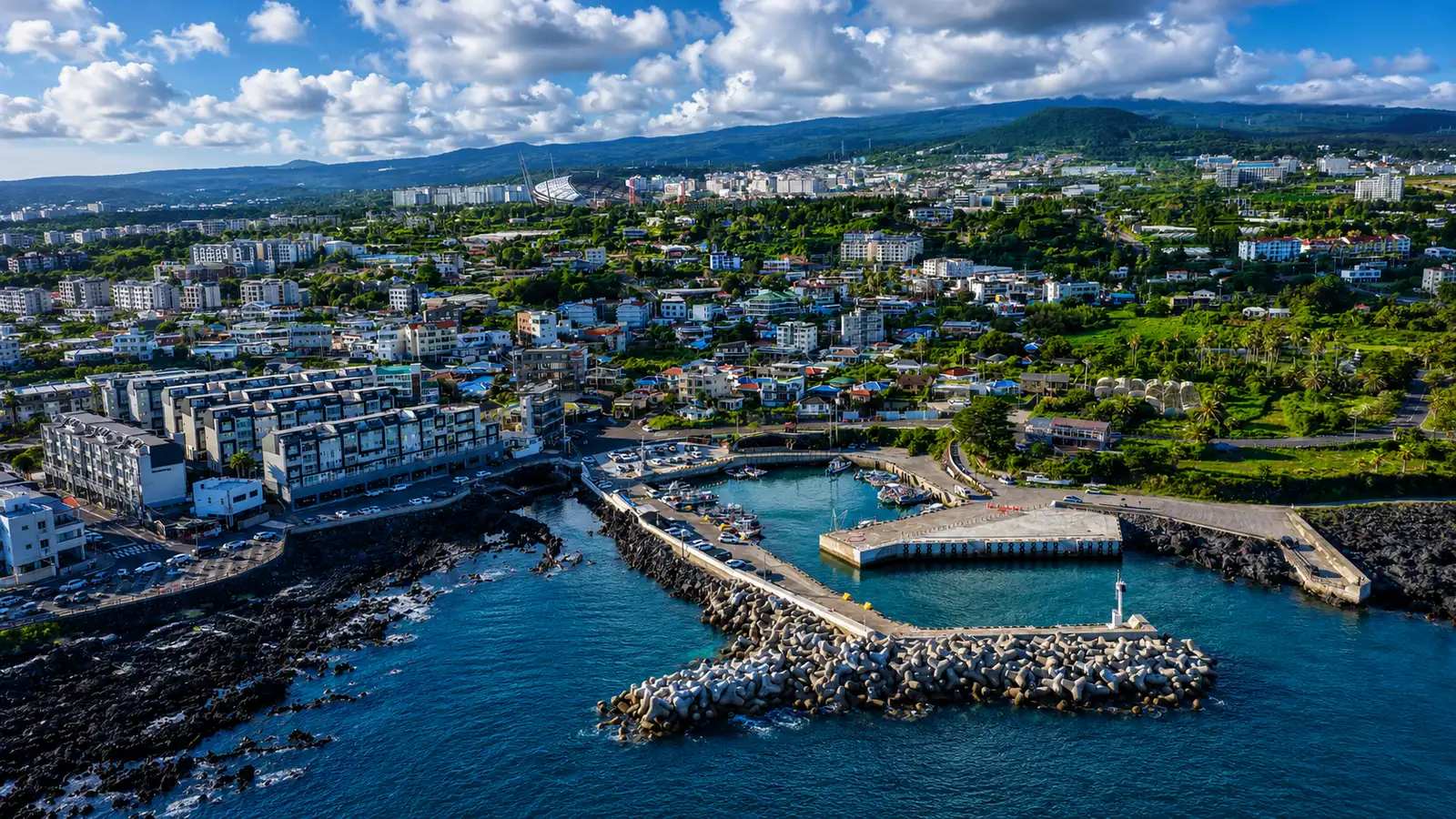
The closest harbour to Beomseom
Beophwan Port (Maksuk)
Beophwan is a small working harbour in Seogwipo, and the closest one to Beomseom, the natural monument island that sits directly off it. Its old name is Maksuk, meaning 'where the tents were pitched': in 1374 General Choe Yeong camped here before crossing to Beomseom to put down the Mokho rebellion. Today it is the village with Korea's first professional haenyeo school, a stretch of Olle Route 7, and the harbour our dive boat leaves from every day.
At a glance
- Location
- Beophwan-dong, Seogwipo, Jeju
- Old name
- Maksuk (幕宿) · the haenyeo village
- To Beomseom
- About 1.3 km · 5 minutes by boat
- Olle trail
- Route 7 passes through
- Parking
- Free around the harbour (busy in peak season)
- Toilets · shower
- Public toilets yes · no shower
First, something we should say plainly
Plenty of write-ups list Beophwan as a spot to get in the water, and in summer we do see people swimming inside the harbour. We would rather you didn't.
Three reasons. Working boats use it: Beophwan is a live fishing harbour, haenyeo and fishing crews come and go, and a skipper cannot easily see a swimmer at the surface. The current turns with the tide, and it changes sharply near the harbour mouth. And from April 2027, swimming and diving inside port areas is prohibited by law.
If you want to see what this water actually holds, the answer is not inside the harbour but out of it. Five minutes by boat and you are at Beomseom.
Beophwan is not a place you get into. It is a place you leave from, and it has been for six and a half centuries.
Maksuk: in 1374 they crossed to Beomseom from here
Maksuk means 'tents, pitched and slept in'. In 1374 the Mokho, Mongol horse-keepers who ran the pastures Yuan China had established on Jeju, rose in revolt when Goryeo agreed to send horses to Ming.
Goryeo sent Choe Yeong with some twenty-five thousand troops. The last of the Mokho withdrew to Beomseom, held out there, and took their own lives. The place where Choe Yeong's army camped facing that island is the harbour that stands here now, and the name stayed.
The five minutes of water we cross every morning is the water they crossed. From below the cliffs of Beomseom you can see at a glance how few places there are to land a boat, and standing out there, it becomes obvious why they chose it for a last stand.
The haenyeo village: Korea's first haenyeo school
Beophwan has long been called the haenyeo village. Beside the harbour stands the Beophwan Jomnyeo Village Haenyeo School, which opened its first class in 2015, the first school in Korea to train haenyeo as a profession.
Two hundred and seventy-two people have graduated; eighty-one work as haenyeo. Roughly three in ten stay, which tells you this is a trade, not an experience.
As divers we should add something. We carry a tank and stay down twenty minutes. They do it on one breath, without gear, for a working lifetime. Same sea, entirely different job. When we see a taewak, the float a haenyeo works beside, our boat gives it a wide berth. That is not courtesy; it is the rule.
Spring water, the barefoot walk, and Olle Route 7
Beophwan still has the pieces a Jeju harbour is made of. The spring water is rain that soaked into Hallasan, travelled down through basalt, and surfaces at the shore, cold even in August. It was the village's drinking water and its laundry, and it still runs. There is also a barefoot walking area along the shore.
Olle Route 7 runs through the harbour. The stretch from central Seogwipo to Wolpyeong keeps the sea in view longer than almost any other Olle route, and the Beophwan section is the part where Beomseom stays straight ahead of you the whole way.
If you are photographing it, the end of the eastern breakwater gives the best angle on Beomseom. Mornings are backlit and the island reads as a silhouette; after about three in the afternoon the texture of the cliffs comes back.
Wind: what actually decides whether we sail
What decides whether the boat goes out is usually not the waves but the wind. A strong southerly or south-westerly makes the points on Beomseom's south side hard to reach. A northerly is often the opposite: the island blocks it, and the water behind is calmer than you would guess.
So when people ask whether rain cancels a dive, the answer is usually no. Rain means nothing once you are under. What cancels dives is wind.
What an instructor sees off Beophwan
From the harbour, Beomseom is just a rock. Underwater it is a different place. In the five minutes out, the bottom drops away fast; close to the island a near-vertical wall begins, and the soft coral is growing on it. That is the colony designated Natural Monument No. 442.
They are called flowers of the sea for their resemblance to cockscomb, and up close pink and orange and yellow cover the whole wall. A colony like this in a temperate sea is internationally unusual, and it exists because a branch of the Kuroshio current runs past the south of Jeju.
And the damselfish. There is a moment when a silver school closes around you, and for most first-timers that is the picture that stays.
The sea through the year
| Period | Water | Visibility | Notes |
|---|---|---|---|
| Mar–May | 14–18℃ | Fair | Cold, but clearing week by week |
| Jun–Aug | 24–27℃ | Slightly murky | Warmest, but affected by the rainy season and plankton |
| Sep–Nov | 20–24℃ | Best of the year | The one stretch where warmth and visibility line up |
| Dec–Feb | 13–16℃ | Good | Fine with the right suit; wind is the variable |
Water temperature and visibility come from our own logbook. They are observations, not guarantees, and they vary year to year.
Two ways to meet the sea off Beophwan
| Beomseom Skin Diving (mask, snorkel, life vest) | Beomseom Boat Discover Dive | |
|---|---|---|
| Price | ₩59,000 | ₩100,000 |
| Licence | Not required | Not required |
| Swimming | Not needed | Not needed |
| Duration | About 1.5–2 hours in total · around 30–40 minutes at the surface | About 2.5–3 hours in total · around 20 minutes underwater |
| Gear included | Ride on our own boat · Mask, snorkel and life vest · Instructor guide | Ride on our own boat (about 5 minutes from Beophwan Port to Beomseom) · Dive photos & video included · All dive equipment · One internationally certified instructor per participant · Shower, towel, hairdryer, shampoo, conditioner and body wash |
Both leave Beophwan Port on our own boat and reach Beomseom in about 5 minutes.
Getting there, parking, facilities
There is free parking around the harbour. On July and August weekends after about ten in the morning, finding a space gets hard. If that is when you are coming, park out on the coastal road and walk in; it is faster.
There are public toilets but no shower. A convenience store is within walking distance, and there is not much shade in the middle of a summer day.
The real inconvenience around here is that there is nowhere to rinse off afterwards. Our centre is five minutes from the harbour by car, with showers, changing rooms, towels, dryers and toiletries.
Frequently asked questions
Can I swim at Beophwan Port?
We would advise against it. It is a working harbour with boats coming and going, the current turns with the tide, and from April 2027 swimming and diving inside port areas is prohibited by law. If you want to get in the water, going out by boat is the safe way.
How long does it take to reach Beomseom from Beophwan?
About 1.3 km in a straight line, roughly five minutes on our own boat.
Can I land on Beomseom?
It is a protected area, so general landing is restricted. Beomseom is not an island you climb; it is one you go around and under.
Is parking free?
Yes, free around the harbour, but very busy on July and August weekend mornings.
Is there anywhere to shower near Beophwan Port?
Not at the harbour itself. Our centre, five minutes away by car, has showers and changing rooms with towels, dryers and toiletries.
Can I visit the haenyeo school?
It is a training institution running a professional haenyeo course. Whether visitors can look around, and when, is something to ask the school directly.
When is the best time to come?
For the water, September to November. It is still 20–24℃ and the visibility is the best of the year. For photographs, the eastern breakwater after about three in the afternoon.
The water they crossed in 1374 takes us five minutes
You do not need to be able to swim. A certified instructor stays with you one-on-one from descent to ascent.
Sources
- The Mokho rebellion and the name Maksuk, Encyclopedia of Korean Culture
- Haenyeo school graduate figures, Seogwipo Newspaper
- Beophwan Jomnyeo Village Haenyeo School
- General information on Beophwan Port, Visit Jeju
The name Maksuk dates to the 1374 Mokho rebellion, 652 years ago this year.