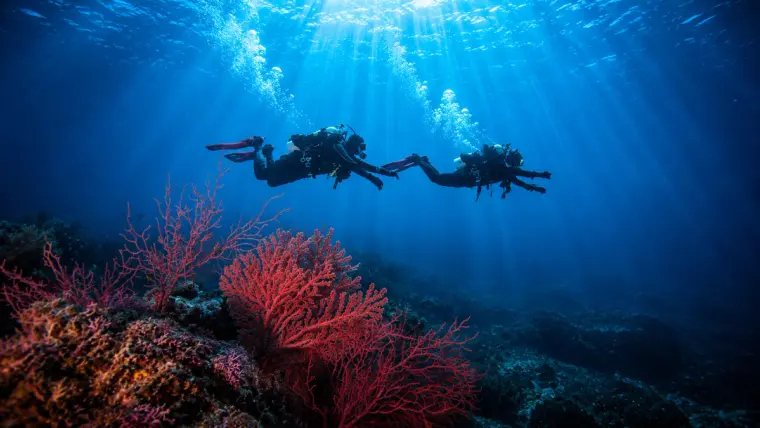
Can You Scuba Dive If You Can't Swim? An Honest Answer
The short answer is yes. Why swimming and diving are different skills, the step-by-step process, and honest answers to every common worry.
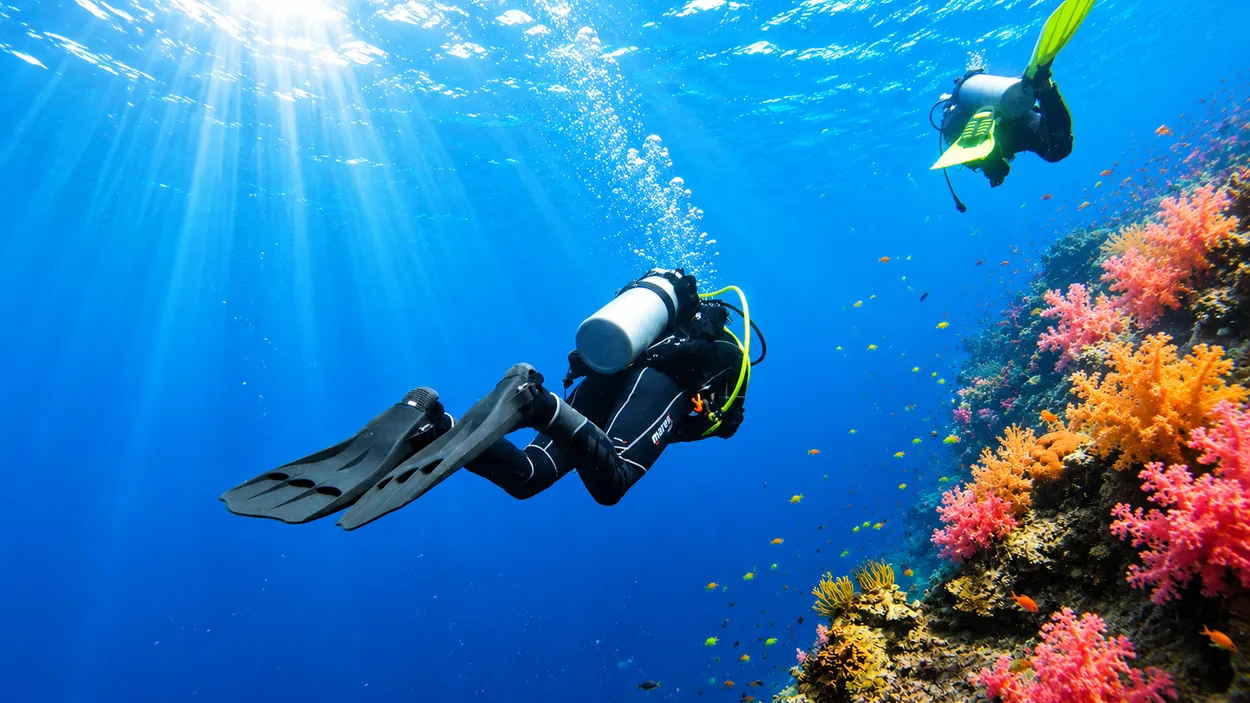
Yes, you can scuba dive (a discover dive) even if you can't swim. Scuba isn't about staying afloat; it's about breathing through equipment and moving underwater, a completely different skill set from swimming. A large share of the discover divers we guide at Beomseom can't swim at all, and their reviews built our 4.9 rating. There are conditions too, this article covers the principle, the conditions, and what actually happens on the day, honestly.
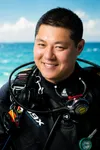
“Staying afloat is the BCD's job, not yours. From entry to ascent, I'm holding onto you one-on-one.” Bae Kyung-jo, RAID Master Instructor · SSI Advanced Instructor
Three reasons swimming and diving are different
| Aspect | Swimming | Scuba diving |
|---|---|---|
| Breathing | Hold your breath or turn to breathe | Breathe continuously through a regulator |
| Floating | Your body creates buoyancy | The BCD and weights do it, one button to rise or sink |
| Moving | Swim yourself (freestyle, breaststroke) | Just a slow fin kick, on a discover dive the instructor stays 1-on-1; you never swim alone |
What fear of water really is, and the paradox that dissolves it
Break down the fear of water and it's usually two things: "I can't breathe underwater" and "my feet can't touch the bottom." Scuba flips both on their head.
- Can't breathe? → Scuba is the sport of breathing underwater. The tank on your back feeds air through the regulator continuously, you stay at any depth, breathing as long as you like
- Feet can't touch? → In diving, you don't need the bottom at all. At neutral buoyancy you hang in the water like a spacewalk
Hence a paradox we see constantly: the moment a water-fearful guest confirms "I can actually breathe down here," a wall that ten years of pool visits couldn't break falls in twenty minutes. For us, it's a familiar scene.
What you do need (the honest part)
You need only three things, no extreme fear of water, basic health (no heart or respiratory conditions or certain histories), and a willingness to follow the instructor. Swimming ability is not on the list.
- No extreme panic in water being scared is fine; almost everyone starts scared. If water touching your face is genuinely unbearable, we simply extend the shallow-water adaptation time
- Basic health heart or respiratory conditions, ear surgery history, and pregnancy restrict participation; check the questionnaire at booking. A blocked nose from a same-day cold also makes equalizing hard
- Following your instructor learning to equalize and a few hand signals beforehand is all it takes
The actual sequence, a Beomseom discover dive, step by step
- Meet & gear fitting: wetsuit and equipment sized to you. Everything is included, bring a swimsuit
- Land briefing (10–20 min): breathing from the regulator, equalizing your ears, three or four hand signals. It's guidance, not a test
- Shallow-water adaptation, the unhurried stage: you start where your feet touch. Breathe standing up → face in the water → lie forward at knee depth. We do not move on until you're comfortable
- Into the sea with your instructor: when you're ready, the instructor holds your hand or tank and moves with you, 20–30 minutes over Beomseom's soft coral grounds, a five-minute boat ride into a natural-monument sea
- Stop anytime: one "up" signal and we surface immediately. Stopping is fine, the sea will be here next time
The reassurance techniques an instructor actually uses
Years of guiding first-timers settle into a routine: constant eye contact, pausing to exchange OK signs at the first hint of anxiety, descending one meter at a time while checking ears, and never letting go of your hand underwater. Discover-dive safety is half equipment, half this routine, which is why one-on-one isn't a feature, it's the core.
Quick answers to the worries non-swimmers ask most
- "What if I swallow water?" → As long as the regulator is in your mouth, water doesn't get in. You'll learn to recover it in the briefing just in case
- "What if my mask floods?" → Your instructor handles it on the spot. Vision blurs for a moment; breathing is unaffected
- "What if my ears hurt?" → You'll learn to equalize early and often; if they hurt, we stop and descend again slowly
- "I wear glasses" → Contact lenses are fine underwater, and prescription masks are available, tell us your eyesight when booking
- "Am I too old / is my child too young?" → Usually from age 10, and with good health there's practically no upper limit. Parent-and-child pairs are common
A scene we see all the time
Sometimes one real scene explains more than any argument. The most common one: a mother in her fifties or sixties on a family trip. She starts with "I'll just watch from the boat," reluctantly sits in on the briefing, tries breathing from the regulator in shallow water, and her expression changes. That day, she's the last one out of the water in her family. What she says afterward is almost always the same: "If I'd known, I would have done this years ago."
Swimming ability appears nowhere in that scene. All it takes is one confirmation, "I can breathe", and trust in the instructor beside you.
The night-before checklist, condition is half the dive
- Sleep well: fatigue slows underwater adaptation
- No heavy drinking the night before: diving after alcohol is a no-go, and a hangover interferes with equalizing
- Check for colds and congestion: a blocked nose makes equalizing hard and can rule out same-day participation, message us if unsure
- A light breakfast: neither empty-stomach nor a feast
- What to bring: swimsuit (wearing it under your clothes is easiest), towel, toiletries. All equipment is included
- Check your flight: at least 12 hours between diving and flying, the scheduling logic is in the 3-day itinerary
If you fall for it, the next step
If the dive leaves you wanting more, Open Water certification is next. Honestly: the Open Water course has no swim test swim assessments are only required of people training to become instructors. We've watched plenty of guests go from a discover dive straight into certification, the full comparison is in discover diving vs. Open Water. For making peace with the water, a discover dive is all you need.
FAQ
Can I really dive if I can't swim at all?
Yes. On a discover dive you breathe through a regulator, the buoyancy vest handles floating and sinking, and a certified instructor accompanies you one-on-one, so swimming ability isn't required. Many discover divers are non-swimmers.
I'm scared of water, is that okay?
Most discover divers start out scared. Scuba directly resolves the core fear, not being able to breathe, because you breathe continuously underwater, and you only move on from standing-depth water once you're comfortable. You can stop at any time.
What do I learn before a discover dive?
A land briefing covers using the regulator, equalizing ear pressure, and basic hand signals, about 10–20 minutes. Everything else, the instructor handles with you in real time underwater.
Can I dive with glasses or contact lenses?
Contact lenses work fine underwater, and prescription masks are available for glasses wearers, share your eyesight when booking and we'll prepare the right mask.
Can a non-swimmer get the Open Water certification?
Yes, the Open Water course has no swim assessment; swim tests are only required of people training to become instructors. A discover dive first is a great way to build water comfort.
About the author
Related Posts