Beomseom Diving Guide: Points, Seasons, How to Go (2026)
Diving Beomseom, Jeju: depths point by point, water temperature and wetsuit by season, the marine life, how to get there and the safety rules.
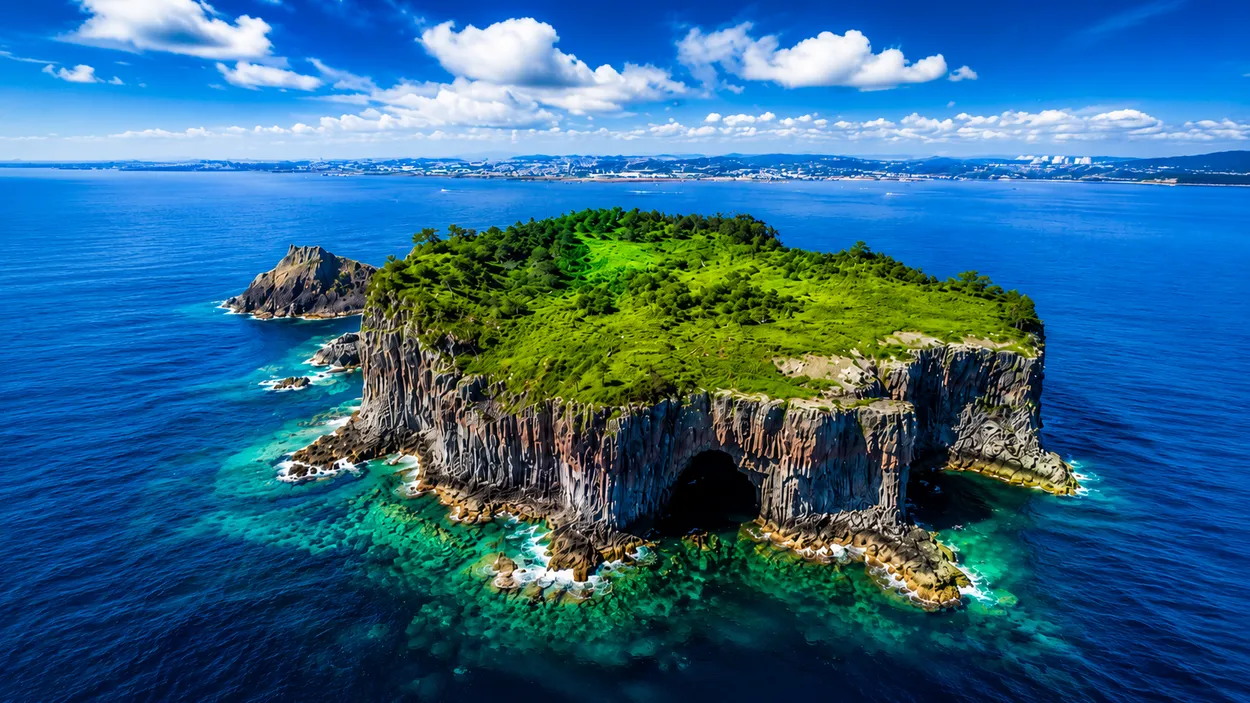
Beomseom diving is boat diving around Beomseom Island, a natural reserve just five minutes or so by boat from Seogwipo harbor, Jeju. In one sea you get Korea's largest soft coral colonies (Natural Monument No. 442), columnar-basalt walls, and sea-cave terrain, which is why it's counted among Korea's definitive dives. Complete beginners, even non-swimmers, can join a discover dive; certified divers tour named points like Train Rock and the Nostril. This is the definitive guide, written by an instructor who dives Beomseom every day.
What kind of island is Beomseom? A tiger, a volcano, and a giant's legend
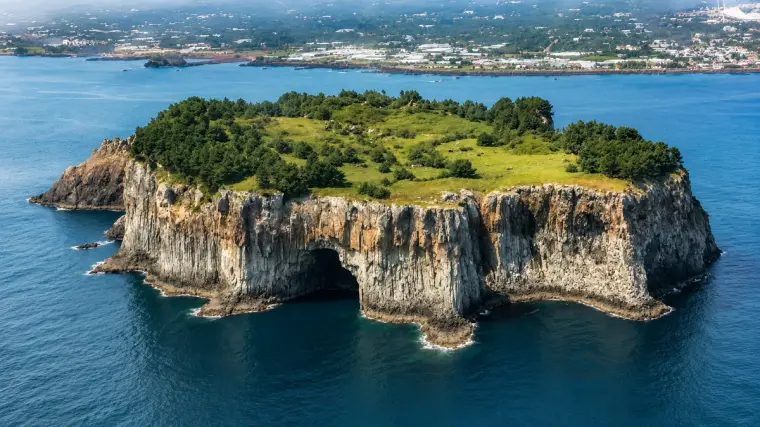
Beomseom ("Tiger Island") is an uninhabited island off Seogwipo, named for its crouching-tiger silhouette. Geologically it's a trachyte lava dome born in volcanic eruptions about 800,000 years ago, a triplet with neighboring Munseom and Seopseom. Lava quenched by seawater left columnar joints wrapping the island's cliffs, and those columns continue straight down below the surface, becoming the dive sites.
The island's north cliff is pierced by twin caves said to resemble a tiger's nostrils, hence the point's name, "the Nostril" (Kotgumeong). Legend says Seolmundae Halmang, the giant grandmother who created Jeju, punched them through with her outstretched legs while using Hallasan as her pillow. Divers pass beneath that legend.
The area was designated Natural Monument No. 421 (Munseom & Beomseom Natural Reserve) in 2000, and its soft coral colonies separately became Natural Monument No. 442 in 2004, a sea the state has stamped twice for protection.
The points, depths and character
Beomseom has four main dive points from 10 to 32m, Train Rock, the Nostril, Saekki Island, and the Wall. Beginners start at Saekki Island and the Wall; certified divers head for Train Rock and the Nostril.
| Point | Depth | What it is | Level |
|---|---|---|---|
| Train Rock | 14–32m | Coral-covered rock mounds running like train cars, Beomseom's best | Fun dive |
| The Nostril | ~14m | Columnar joints running underwater + a swim beneath the twin sea caves | Fun dive |
| Saekki Island | ~14m | The islet beside Beomseom; entry from a flat wave-cut platform, ideal for training | Discover–Fun |
| The Wall | 10–25m | A sheer face blanketed in soft corals and damselfish | Discover–Fun |
Y-axis = depth (m, surface at 0). Bars show each point's dive depth; the top band is the shallow zone where discover dives take place.
Train Rock is the headliner, named Beomseom's best point by a Korean diving column. Its ridge of rocky mounds runs like a train, the whole spine dressed in soft corals, so the scenery never breaks at any depth. The Nostril follows the columnar wall to the legendary twin caves; Saekki Island's flat rock platform makes it the natural base for training and discover dives.
What marine life will you meet underwater at Beomseom?
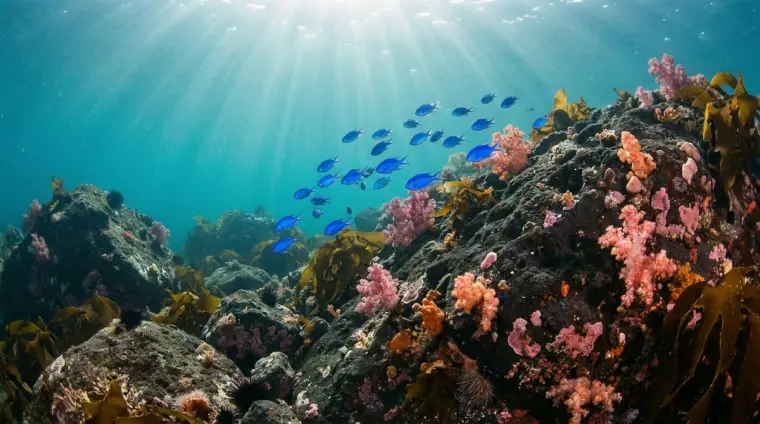
Underwater at Beomseom you'll meet soft-coral colonies (Dendronephthya), damselfish schools, nudibranchs, a kelp forest, and, increasingly, subtropical fish.
- Soft corals (Dendronephthya): the stars. Crimson, violet, and orange colonies blanket the walls, why they're a national treasure is covered separately
- Damselfish schools: in summer they wrap divers like a cloud, the signature of Jeju's sea
- Nudibranchs: fingernail-sized and outrageously colored, why macro photographers come here
- Kelp forest: temperate-sea forests the tropics don't have; flying through them feels like a woodland
- Subtropical arrivals: with warming water, southern species like anemonefish are now settling in
The same point changes its lead actor by season, damselfish in summer, peak visibility in autumn, and surprisingly clear water in winter.
Season, temperature, and wetsuit guide
Beomseom dives year-round. Summer and autumn (Jun–Nov) run 18–28°C with a 5mm wetsuit; winter (Dec–Feb) sits around 15°C with a hood; spring (Mar–May) is coldest, so a drysuit is best. Visibility peaks from September to November.
| Season | Water temp | Suit | Notes |
|---|---|---|---|
| Jun–Aug | 18–24°C | 5mm wetsuit | Damselfish spawning, "half water, half fish" |
| Sep–Nov | 22–28°C | 3–5mm wetsuit | Prime. September feels like Southeast Asia |
| Dec–Feb | ~15°C | 5mm + hood | The best visibility of the year |
| Mar–May | ~15°C | Drysuit advised | The coldest window, experienced divers |
Y-axis = water temp (°C). Bars show each season's range; ★ autumn (Sep–Nov) is the prime window for temperature and visibility.
Visibility averages 10–20m, among Korea's best, dipping temporarily after typhoons or heavy rain. Jeju is effectively Korea's only year-round dive destination.
“From September to November, Beomseom's water is at its clearest. On those days, standing before the wall, you can hear guests' breathing change through their regulators.” Bae Kyung-jo, RAID Master Instructor · SSI Advanced Instructor
How to join, which course fits you
There are three ways to dive Beomseom, a discover dive (no license or swimming needed), fun dives for certified divers (two boat tanks), and a 3–4 day Open Water course.
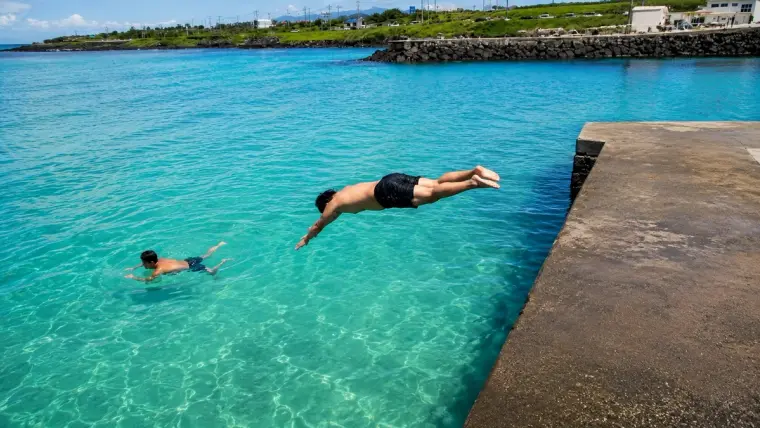
- Discover dive: no license, no swimming needed. An instructor accompanies you one-on-one over the gentle coral grounds at Saekki Island and the Wall, here's why non-swimmers can dive
- Fun dive: two boat tanks for certified divers, the Train Rock and Nostril tour
- Open Water course: 3–4 days, with Beomseom itself as your training sea. Deciding between an experience and a license? Compare here
The day's flow: meet at the center (8:30am) → gear fitting → boat out of Seogwipo harbor → dive Beomseom → done around noon. Discover dives include full gear rental, bring a swimsuit and towel. (Fun diving: gear rental separate; skin diving: wetsuit rental separate.)
Beomseom vs. Munseom, what's the difference?
In one sentence: either works for getting comfortable in the water, but the dive that stays with you as 'the picture of Jeju' is Beomseom, which is exactly why we make it our home ground.
Research Seogwipo diving and you'll inevitably compare the two. Both sit in the same natural reserve (No. 421) and were born together 800,000 years ago, but they dive differently.
- Munseom: right off Seogwipo harbor, the fastest access, and where much of the training happens. In peak season, diver density runs higher
- Beomseom: a few more minutes by boat buys you larger-scale terrain, Train Rock, the Nostril, and a quieter sea. For the three-dimensional drama of columnar walls and sea caves, Beomseom clearly wins
Getting there and booking tips
- Meeting point: the Nautilus Dive center in downtown Seogwipo, the boat reaches the points in about five minutes
- Booking: boats have limited seats; in peak season (July–September) book several days ahead. In rough weather, sailing is confirmed the day before
“If the sea isn't right, we cancel first and offer a full refund or a new date. It's disappointing, but that's diving.” Bae Kyung-jo, RAID Master Instructor · SSI Advanced Instructor
- Your afternoon is free: dives finish by noon, see the 3-day Seogwipo itinerary built around post-dive altitude rules
Safety and reserve rules, the non-negotiables
- No collecting, no touching: this is a natural reserve, corals and marine life are for eyes and cameras only
- Altitude and flying after diving: avoid Hallasan and the highlands (above ~300m) right after diving; fly no sooner than 12 hours after a single dive (18+ after repetitive dives)
- Health screening: heart or respiratory conditions and pregnancy restrict participation, check the questionnaire at booking
- No alcohol before diving: heavy drinking the night before counts
FAQ
Where and how do you dive Beomseom?
Dives run around Beomseom Island, about five minutes by boat from Seogwipo harbor in Jeju. Book with a Seogwipo dive center such as Nautilus Dive and the day includes gear fitting, the boat ride, and an instructor guide.
What are Beomseom's signature dive points?
Train Rock (14–32m, coral-covered mounds running like train cars), the Nostril (~14m, columnar walls and twin sea caves), Saekki Island (~14m, entry from a flat rock platform), and the soft-coral Wall (10–25m).
When is the best time to dive Beomseom?
June to November at 18–28°C, with September–October the peak for both temperature and visibility. Even in winter the water rarely drops below 15°C, wetsuit diving continues, and visibility is often at its best.
Can beginners or non-swimmers dive Beomseom?
Yes. On a discover dive a certified instructor accompanies you one-on-one, and the regulator and buoyancy gear handle breathing and floating, no swimming ability required. Many participants are non-swimmers.
Why is Beomseom a natural monument?
The Munseom–Beomseom area was designated Natural Monument No. 421 in 2000 for its volcanic terrain and marine ecosystem, and its soft coral colonies were separately designated Natural Monument No. 442 in 2004.
About the author
Related Posts