Beomseom, Seogwipo: The Complete Diving Guide
Beomseom in Seogwipo, where Natural Monuments No. 421 and No. 442 overlap: geology, soft-coral ecology, the Mokho Rebellion, seasons and dive points.
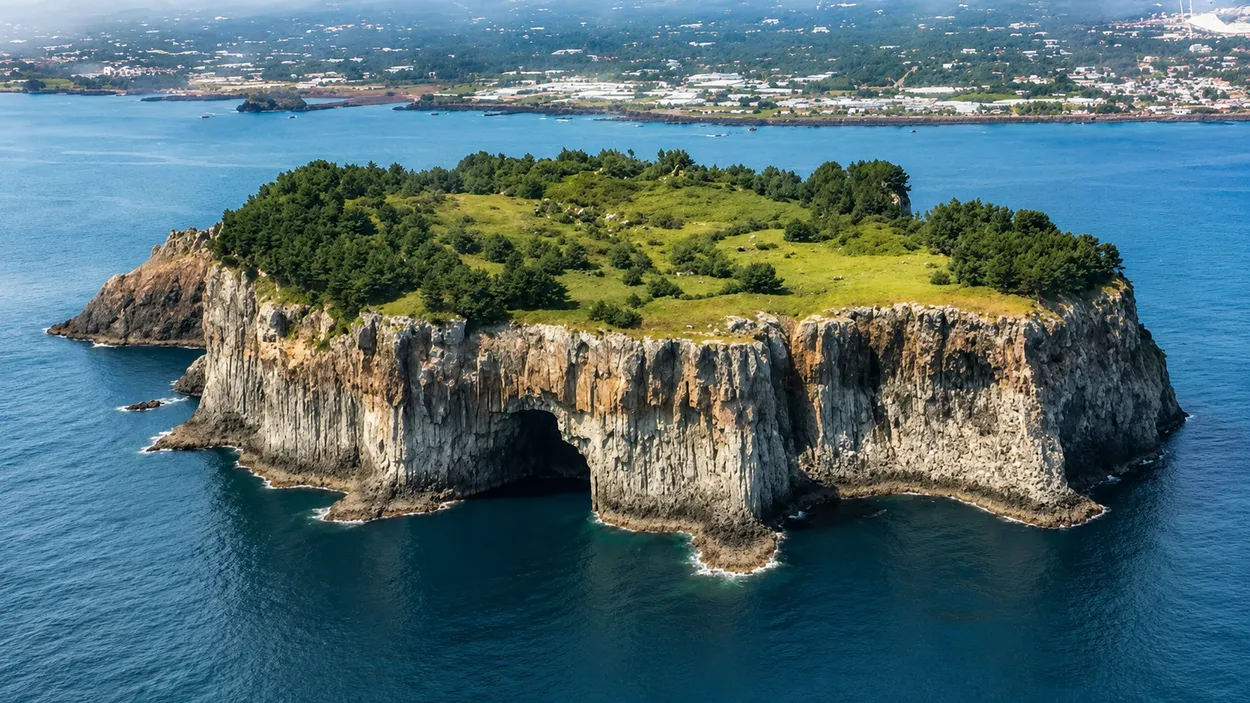
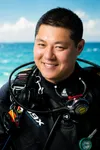
Beomseom (Tiger Island) is an uninhabited islet in the sea off Seogwipo, Jeju, where two of Korea's national treasures overlap, Natural Monument No. 421 (the Munseom–Beomseom Natural Reserve) and No. 442 (the Jeju Coastal Soft-Coral Habitat), making it one of the country's premier soft-coral dive sites. It lies about 1.3 km south of the Seogwipo coast, and its trachyte lava dome, columnar-jointed cliffs and sea caves (the “Nostrils”) continue straight underwater to form dive points roughly 7–27 m deep. You can join even without knowing how to swim, on a guided boat discover dive, and visibility is best from September to November.
This article brings together what Beomseom is and why it is special, based on official sources such as the Korea Heritage Service and the Jeju provincial government. For how to dive it, point-by-point routes and what to bring, see the Complete Beomseom Diving Guide.
What is Beomseom?
Beomseom is an uninhabited islet in the sea off Seogwipo City, Jeju. Per the Korea Heritage Service it lies about 1.3 km south of the Seogwipo coast, and the entire island is designated a natural reserve. It covers about 84,298 ㎡, is roughly round at about 440 m east–west and 520 m north–south, and its highest point is about 87 m. Seen from afar its silhouette resembles a crouching tiger (beom), which is how it got its name,written 虎島 (Tiger Island) in Chinese characters. No one lives there today, but the real reason Beomseom is famous lies not above the island but in the sea beneath it.
A sea where two Natural Monuments overlap
Beomseom's defining feature is that a single dive puts you in touch with two Natural Monuments. The island itself and the sea around it are protected as two separate national cultural properties, a double layer of protection.
Natural Monument No. 421, Munseom–Beomseom Natural Reserve
On 18 July 2000 the Korea Heritage Service designated Beomseom and Munseom and their surrounding waters as Natural Monument No. 421, the “Munseom–Beomseom Natural Reserve.” The designated area reaches 9,196,822 ㎡. The reasons cited were the trachyte scenery and the rich subtropical marine biodiversity brought by the warm current. In other words, Beomseom was designated not as “a single island” but as “a protected sea.”
Natural Monument No. 442, Jeju Coastal Soft-Coral Habitat
That sea is also part of the protection framework of Natural Monument No. 442, the “Jeju Coastal Soft-Coral Habitat,” designated on 13 December 2004. One point deserves precision here: “Korea's largest soft-coral colony” refers not to Beomseom alone but to the entire southern coast of Jeju, spanning Munseom, Beomseom and Seopseom. About 92 of Korea's 132 anthozoan species live along Jeju's coast, and Beomseom sits at the very heart of that largest colony.
UNESCO Biosphere Reserve core area
On top of this, the waters around Beomseom fall within the core area of Jeju's UNESCO Biosphere Reserve, designated in 2002. It is a rare sea in Korea where the country's highest grades of protection are layered several deep.
How Beomseom was formed, a trachyte lava dome and the “Nostrils”
Beomseom is made not of the black basalt common to Jeju but of trachyte, a volcanic rock. Highly viscous trachyte lava could not flow far and hardened over its vent into a gently rounded lava dome. As it cooled and contracted it left columnar joints across the cliffs, and over ages the waves carved four sea caves into them. One of them is the “Nostrils” (Kotgumeong), famous among divers.
Its age is worth citing from the latest research. In 2026 the Jeju World Heritage Office re-dated the island by precise Ar-Ar geochronology and announced that Beomseom formed about 804,000 years ago (Munseom about 824,000 years, Seopseom about 796,000 years), revising the earlier estimate of about 730,000 years.
The name,the island shaped like a tiger (虎島)
The name Beomseom comes from the island's distant silhouette resembling a crouching tiger. Aligning uncannily with that tiger's face are the twin sea caves in the northern cliff, the “Nostrils.” Legend also holds that Seolmundae Halmang, the giant who created Jeju, bored these caves with her two legs as she lay resting her head on Mt. Halla.
Beneath Beomseom, a garden of soft coral and its residents
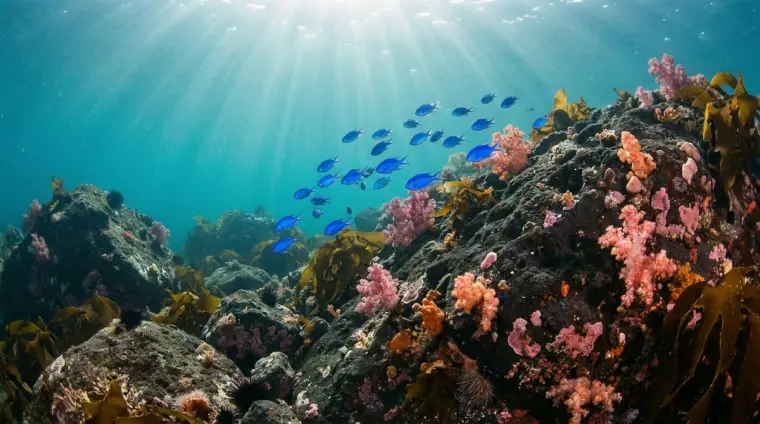
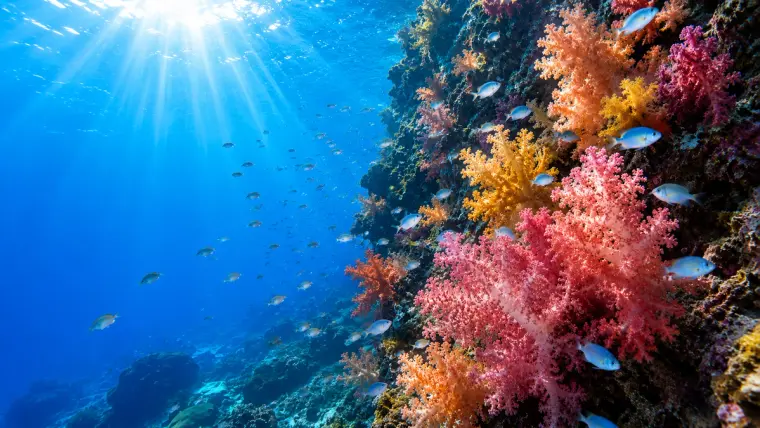
The star of a Beomseom dive is soft coral. Soft corals are animals, not plants; lacking a hard skeleton, they feed on plankton carried by the current and bloom like flowers. Swaying colonies blanket the walls, earning the nickname “undersea flower garden.” The species repeatedly recorded at Beomseom include:
- Pink soft coral (Scleronephthya gracillimum), the signature pink soft coral of Beomseom
- Giant tree coral (Dendronephthya gigantea), a large colony growing up to about 40 cm
- Chestnut tree coral (Dendronephthya castanea), a Class II endangered species (Korea's Ministry of Environment)
- Black coral and branching black coral protected cnidarian colonies alongside them
Silver damselfish schools fill the gaps between these coral walls, and by season stripey, amberjack and subtropical fish pass through. Why Beomseom specifically? Because three conditions overlap, the warm Kuroshio Current, a steady supply of plankton, and rocky terrain that channels the current. Jeju's southern coast is among the northernmost seas in the world where soft coral can live. Why the soft coral is a Natural Monument is covered in a separate article.
That said, in the summer of 2024 the sea off southern Jeju hit record-high temperatures and “slumping”, some soft corals drooping, was observed; related research was reported in an international journal in 2026. The Beomseom sea is beautiful and, at the same time, a front line of climate change.
Beomseom dive points at a glance
| Point | Depth | Character |
|---|---|---|
| Nostrils (Kotgumeong) | ~10–14 m | Columnar-jointed wall and twin sea caves, light-beam terrain |
| Soft-coral wall (coral garden) | ~14–24 m | Vivid soft coral and black coral, Beomseom's highlight |
| Gichabawi (Train Rock) | ~20–30 m | Coral-covered reef running on like a train, Beomseom's signature |
| Wall / Saekki-seom | ~15–28 m | A vertical drop-off packed with soft coral and damselfish |
General dive depths run about 7–27 m, deeper where there is current. Point-by-point routes, difficulty and what to bring are covered in detail in the Complete Beomseom Diving Guide.
When to go, season and water temperature
Beomseom can be dived year-round, but visibility is best from September to November, once the summer rains have passed, the water clears and it is still warm. Summer water temperatures run about 25–28°C, comfortable in a thin wetsuit, and even in winter the water rarely drops far below 15°C, relatively warm by Korean standards, so wetsuit diving is possible and visibility actually opens up. During the rainy season (mid-June to July) and typhoon season, divable days drop sharply, so check before booking.
Beomseom 700 years ago, the last stand of the Mokho Rebellion
Before it was a dive site, Beomseom was where a chapter of Korean history closed. In 1374 (the 23rd year of King Gongmin of Goryeo), General Choe Yeong subdued the Mongol-descended Mokho forces that had held Jeju in the “Mokho Rebellion,” and the cornered Mokho are said to have made their final stand at Beomseom. The very sea where divers now meet soft coral was, 700 years ago, where a page of Goryeo history came to an end.
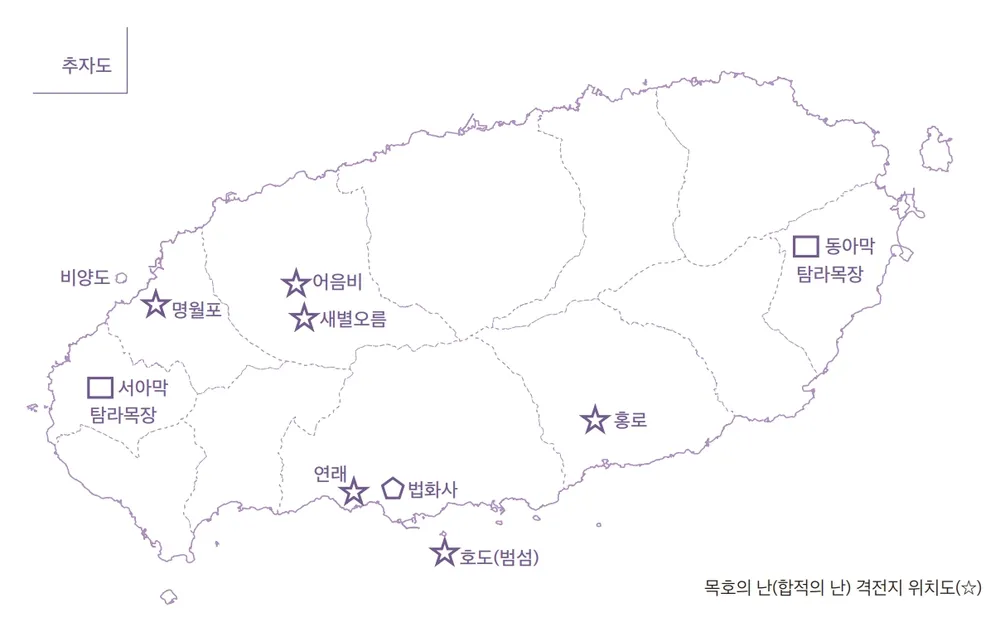
▲ Map of the Mokho Rebellion battle sites, Hodo (Beomseom), off the south coast, was the final stand. Source: Jeju Research Institute
Seogwipo's three great dive islands, Beomseom, Munseom, Seopseom
| Island | In one line | Designation |
|---|---|---|
| Beomseom (虎島) | Sea caves, wall, large soft coral, distinctive terrain | Natural Monument No. 421 |
| Munseom (蚊島) | Most diverse in coral species and numbers, closest to port | Natural Monument No. 421 |
| Seopseom (森島) | Habitat of the bird's-nest fern, relatively quiet | Natural Monument No. 18 |
The three islands share the same Seogwipo sea but wear different faces. Munseom's strengths are coral-species diversity and access; Beomseom's are terrain such as sea caves and walls plus large soft coral; Seopseom's is its relative quiet.
Visiting, safety and reserve rules
- No collecting or touching This is a natural reserve. Take soft coral and marine life only with your eyes and camera; landing on the island is restricted in principle.
- Post-dive flying limit After a discover dive we advise boarding a flight only 12 hours later (18+ hours after repetitive dives).
- Health screening and age Heart and respiratory conditions, pregnancy and similar factors restrict participation. Participants must be aged 10 or over, and minors need a guardian's consent.
FAQ
Can anyone go onto Beomseom?
Beomseom is an uninhabited natural reserve. Landing on the island is restricted, but you can visit by circling it by boat or by meeting its underwater world through diving or skin diving.
Can I dive Beomseom if I can't swim?
Yes. On a boat discover dive an internationally certified instructor accompanies you and a buoyancy control device supports your body, so swimming ability isn't required. Participants aged 10 and over are welcome.
When is the best season to dive Beomseom?
It is divable year-round, but visibility is best from September to November. Summer water temperatures are a warm 25–28°C.
Why is Beomseom a Natural Monument?
The island and its surrounding waters hold trachyte scenery and one of Korea's largest soft-coral colonies, so it is designated, together with Munseom, as Natural Monument No. 421, while the soft-coral colony is separately designated No. 442, giving double protection.
Beomseom or Munseom, which is better?
Munseom's strengths are coral-species diversity and access; Beomseom's are terrain such as sea caves and walls plus large soft coral. It depends on your taste.
How deep is Beomseom diving?
Generally about 7–27 m, the Nostrils around 14 m, and Train Rock and the wall in the 20–30 m range. Exact depth varies with the point and conditions on the day.
The core facts in this article are based on official sources from the Korea Heritage Service, the Jeju Provincial Government, the National Institute of Biological Resources and the Jeju World Heritage Office. Values that vary between sources, water temperature, visibility, depth, are given as ranges and may differ with conditions on the day. To meet Beomseom in person, see the Beomseom dive-zone guide, About Nautilus Dive, and real reviews.
About the author

Related Posts