Jeju's Subtropical Shift: What Divers See Underwater in 2026
Korea's sea hit a record 17.17°C in early 2026. What that changes on a Seogwipo dive: tropical fish arriving, soft coral under stress, how to plan.
Jeju's sea is the warmest it has ever been measured, and you can see it from 15 metres down. Korea's National Institute of Fisheries Science put the average surface temperature of Korean waters at 17.17°C for the first half of 2026, the highest in 26 years of records. On a Seogwipo boat dive that shows up two ways at once: more subtropical fish than any of us saw ten years ago, and visible heat damage to the soft coral colonies those same sites are famous for. Here's what's actually down there this August.
The number behind the change
NIFS released the figure on 9 July 2026. The first-half average of 17.17°C beat the previous record of 16.65°C, set in 2020, by 0.52°C, and ran 1.17°C above the same period in 2025. A separate long-term series running back to 1968 also hit its highest first-half value on record.
Jeju's own numbers are steeper. The Jeju Marine and Fisheries Research Institute surveyed 13 coastal stations in May and June and found surface temperatures 1 to 1.5°C above the previous year. High-temperature advisories are also arriving earlier each season. The institute's director, Kang Bong-jo, framed the problem as heat that comes earlier and stays longer.
This isn't a Jeju quirk. A 2020 study found sea surface temperature in Korean waters climbing at close to 2.5 times the global average rate, with the warm Kuroshio Current shifting roughly 1.7 degrees of latitude north. Jeju sits directly in the path of that shift.
What's actually swimming past you now
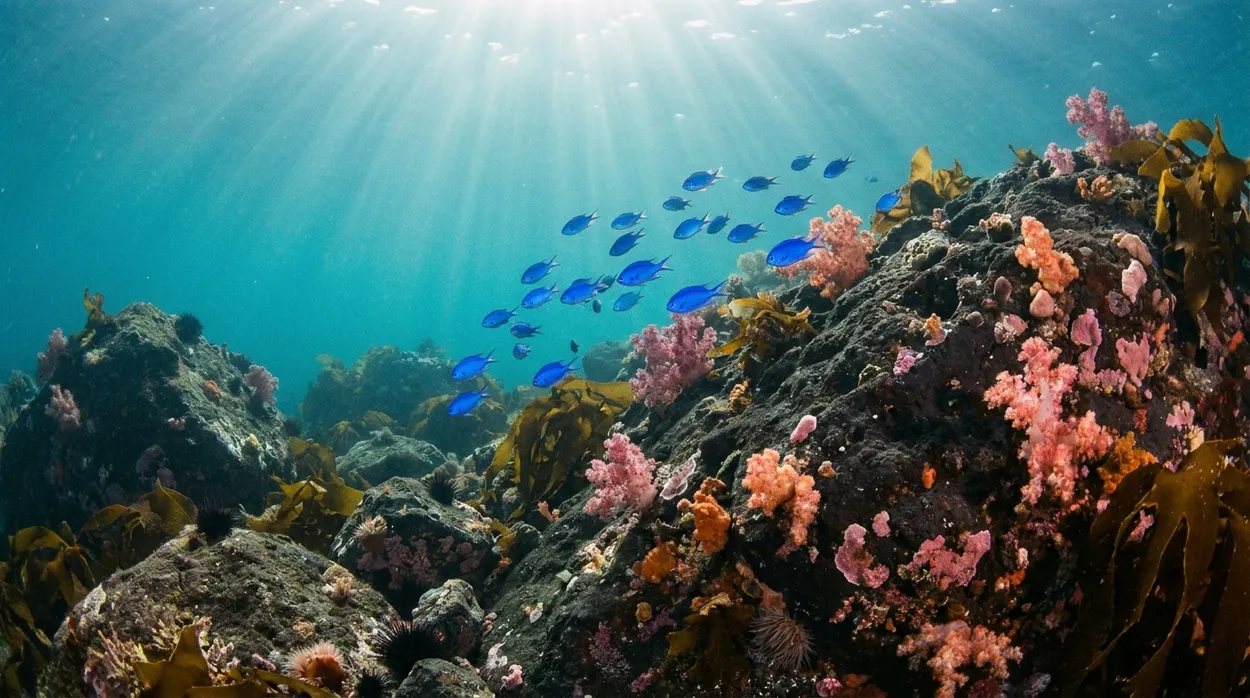
The species divers notice first is the blue damselfish. Korea designated it a climate-change indicator species in 2023, and this finger-sized flash of blue has gone from an occasional visitor from the south to a dominant fish along Jeju's entire coastline. One researcher put it on camera last year: in the water column, blue damselfish have become more common than anchovies.
They aren't alone. Stripey, bluestriped angelfish, porcupinefish and boxfish all turn up on Seogwipo walls without much hunting. The NIFS Jeju Fisheries Research Institute, which has surveyed the island's four coastal quadrants and the water around Gapado since 2012, has reported subtropical species accounting for more than 40% of the fish species recorded. That survey measures catch composition rather than what a diver sees, so don't read it as a headcount for your dive, but the direction matches what keeps showing up in underwater photos.
The headline animals are rarer than the internet makes them look. On the night of 30 June, a boat running squid-fishing trips met a whale shark off Aewol, on Jeju's north coast. Size estimates in the coverage ranged from three to five metres. It made national news precisely because a tropical species turning up in Korean water is an event, not a fixture. Read it as a signal of what the sea is doing, not an item for your dive plan.
| Species | What changed | What it looks like underwater |
|---|---|---|
| Blue damselfish | Designated a climate-change indicator species in 2023; now dominant along Jeju's whole coast | Near-fluorescent blue, hanging in loose clouds over rock and coral. The most visible change in Jeju's underwater scenery this decade. |
| Stripey | Long established in Seogwipo, now reliably abundant | Yellow-and-black bars, curious, often the first fish to come to you. |
| Bluestriped angelfish | Went from a rarity to a regular on the southern walls | Bigger and skittish. A good reason to hold your distance and your buoyancy. |
| Porcupinefish and boxfish | Increasingly reported in Jeju surveys | Slow enough that people crowd them. Don't. |
| Blue swimmer crab | Near-absent until repeated sightings around Jeju from 2025 | Mostly a fisheries story, but it shows how fast the bottom community is reshuffling. |
| Whale shark | One sighting off Aewol, 30 June 2026 | News, not an itinerary. |
The other half of the story: the corals are struggling
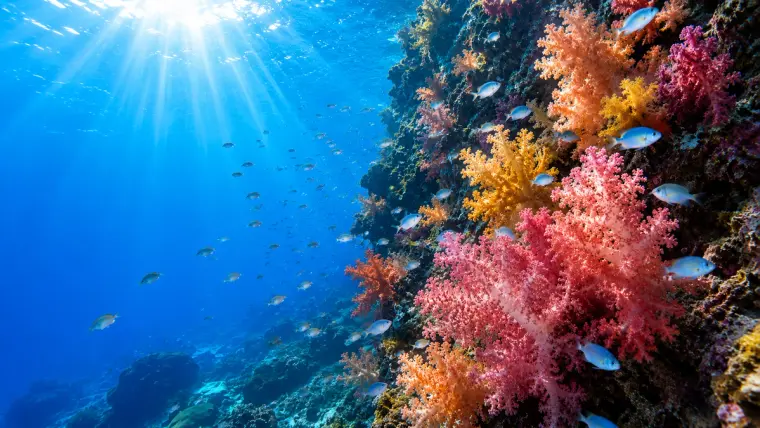
Warm water gives and it takes. In June 2026 a team from KIOST's Tropical and Subtropical Research Center, led by Dr Kim Tae-hun, published work in Scientific Reports documenting what they call slumping in Seogwipo's soft coral colonies a five-stage collapse in which a colony swells abnormally, wilts, inverts, shrivels, and finally disintegrates.
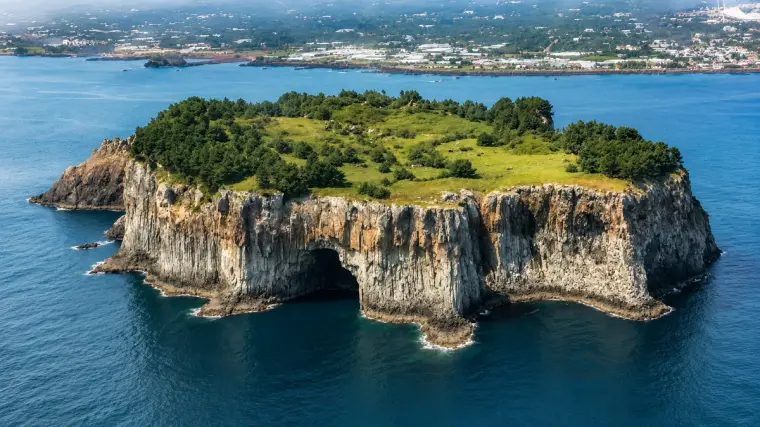
The affected sites read like a Seogwipo dive itinerary: Munseom, Beomseom, and the water off Songaksan. The trigger the team identified was the summer of 2024, the highest average water temperature and the lowest average salinity in ten years, with low-salinity water from Yangtze River discharge lingering for more than 50 days. Co-researcher Dr Anna Jöst explained the mechanism as osmotic: a soft coral holds its shape through pressure balance, and once that balance breaks the colony swells or shrivels until it fails structurally.
This matters because Jeju's soft coral colony is a designated natural monument and the reason a lot of people fly here to dive. So let's be precise: the colonies are not gone. Seogwipo is still one of the best soft coral dives in Northeast Asia. But divers who have been coming back for years are not imagining the change, and the shallows have taken it worst.
What it means for your August dive
On conditions alone, August is a good month. Water temperature peaks now, and it sits inside Jeju's clear-water season of June through November. Four practical things follow.
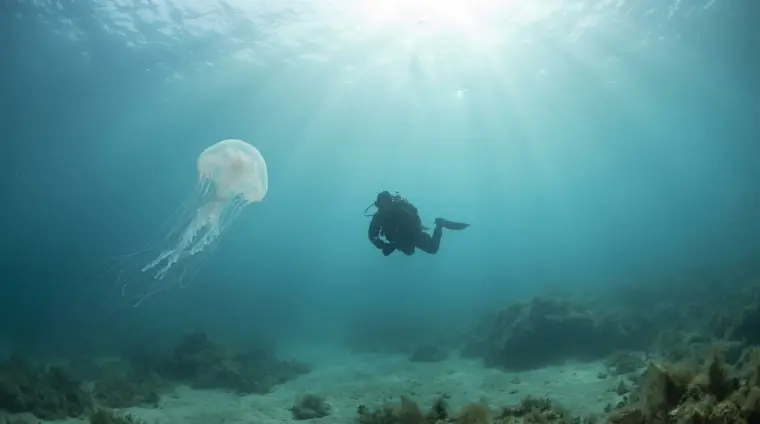
- Wear a full suit. 3 mm is comfortable for most people, and this year the suit is doing two jobs, jellyfish numbers are up as well.
- Use the depth. The heat damage documented at Munseom and Beomseom was worst in shallow water, and the coral walls that made those sites famous run deeper than that.
- Ask the crew what they've been seeing that week. Species composition is genuinely shifting year to year now, and the people putting a boat in the water daily know before the survey reports do.
- You don't need a certification to see this. A discover dive reaches it. The depths where blue damselfish and stripey are thickest are not deep ones.
How to dive a sea that's changing
Keep your hands and fins off the coral. A colony already under osmotic stress does not need mechanical damage on top of it. That sounds obvious, but the shallow reef where buoyancy tends to get sloppiest is exactly the zone the KIOST work found most affected.
And log what you see. Blue damselfish is an official climate-change indicator species, which means a sighting is data rather than trivia. Photograph it, note the site and depth, tell your dive centre. Recreational divers are in this water far more often than research teams are.
Jeju's sea in 2026 is warmer, busier with subtropical fish, and under measurable stress in the shallows. Those aren't three stories, they're one. Diving here now means watching a temperate sea in the middle of turning into something else, a strange privilege, and a good reason to dive it carefully.
FAQ
Is Jeju's soft coral still worth diving in 2026?
Yes. The damage documented at Munseom, Beomseom and Songaksan is real and worst in shallow water, but the colonies remain and Seogwipo is still among the best soft coral diving in Northeast Asia. Ask your dive centre which sites and depths are looking best in the week you're coming.
What tropical fish can I actually expect to see off Seogwipo?
Blue damselfish are close to guaranteed. Stripey, bluestriped angelfish, porcupinefish and boxfish are all common. Animals like whale sharks make the news precisely because they turn up once every few years, so don't book a trip expecting one.
How warm is the water in Jeju in August?
Jeju's July average is recorded at roughly 24.8°C, and August generally runs at or a little above that, because the sea peaks later than the air. A 3 mm full suit suits most divers, and bring a hood if jellyfish are around.
Is warmer water making Jeju diving better or worse?
Both, honestly. More species diversity and comfortable temperatures on one side; coral stress and more jellyfish on the other. Nothing about 2026 makes Jeju a bad place to dive. It makes it a changing one.
Do high-temperature advisories mean diving gets cancelled?
A high-temperature advisory does not ban recreational diving, it's a warning aimed mainly at fish farms and coastal aquaculture. What actually moves a summer dive schedule on Jeju is wind, swell and typhoons. Leave the morning-of call to the crew running the boat.
About the author
Related Posts