Jeju Jellyfish Season 2026: What Divers Need to Know
Nomura's jellyfish hit Jeju two weeks early in 2026, up fivefold. What scuba divers need to know about stings, wetsuit cover, and diving Beomseom safely.
Jeju's jellyfish season really is worse than usual in 2026, and no, that isn't a reason to cancel your dive. Nomura's jellyfish reached Jeju waters about two weeks earlier than normal and are being counted at roughly five times last year's density. But a suited scuba diver sits in a completely different risk category than a swimmer in board shorts. Here's what's actually in the water off Seogwipo this month, what to wear, and what to do if you take a sting.
What's actually happening in Jeju's water this year
The Ministry of Oceans and Fisheries raised Korea's jellyfish crisis alert from "interest" to "caution" on June 8, 2026. The first preliminary advisory had gone out on May 26, ten days earlier than the equivalent advisory in 2025.
The counts behind that decision: the National Institute of Fisheries Science recorded an average of 10 Nomura's jellyfish per hectare in its survey of waters around Jeju and the southern coast, against 2 per hectare in the same period last year. That's a fivefold jump, and the animals showed up roughly two weeks ahead of schedule.
Heat is the driver. The ministry forecast Korean waters running 1.2 to 2.8°C above average this year, and the Korea Meteorological Administration put the odds of above-average sea surface temperatures from July through September at 50 to 70 percent. Warmer water and strong currents out of the East China Sea carry jellyfish north earlier and in greater numbers. NIFS has been upfront that it hasn't identified the exact cause of the surge, these animals originate in Chinese coastal waters the institute can't survey directly.
Jeju isn't alone in this. Sightings have been confirmed in South Jeolla, South Gyeongsang, and Busan waters too.
Why divers aren't in the same boat as swimmers
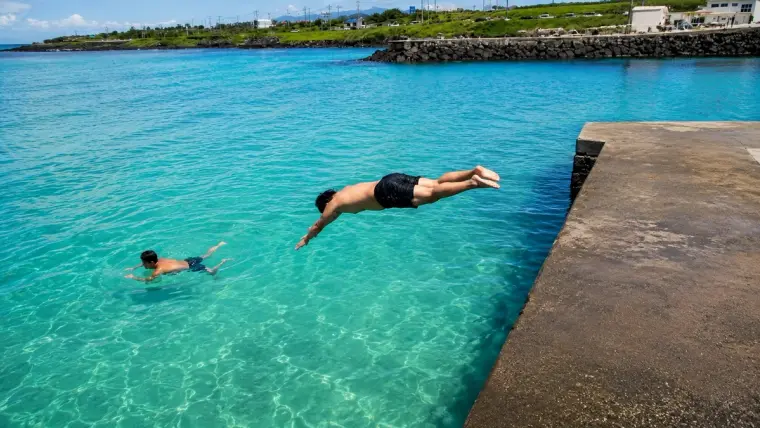
Eight jellyfish sting incidents were reported at Jeju beaches this summer through late July. The most recent, on July 23, involved a teenager at Jungmun Beach here in Seogwipo who was stung and taken to hospital.
Look at where that happened. Jungmun is a surf beach. Someone in swim shorts, at the surface, in the shore break, that's the profile behind almost every sting we hear about.
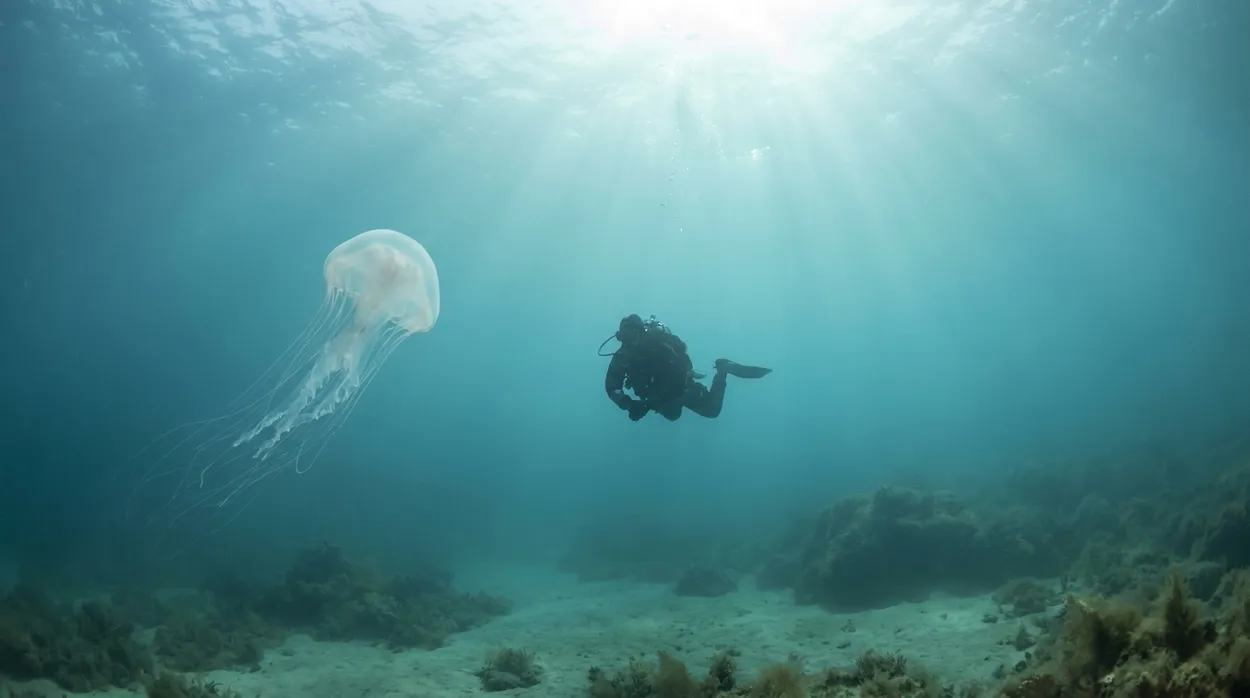
Now picture a Beomseom dive instead. You're in a full-length wetsuit, most of the dive is spent well below the surface, and a guide is watching the water column with you. Nomura's jellyfish are enormous, up to two metres across, and they drift. They don't chase anything. You see one from a long way off and you go around it. The concentration is heaviest in the warm surface layer, which is precisely the part of the water column a diver spends the least time in.
That's not a claim that divers can't be stung. It's a claim that the exposure is manageable, and the tools to manage it are things you're already wearing.
The three species worth knowing about
| Species | Size | Where you meet it | What it means for a suited diver |
|---|---|---|---|
| Nomura's jellyfish | Up to 2 m across | Surface and mid-water; up roughly 5× on last year around Jeju | Large, slow, easy to spot and swim around. Stings can bring swelling, fever and numbness. |
| Ghost jellyfish | Much smaller, far less obvious | Reported with increasing frequency in Korean waters this year | Highly venomous. The one to take seriously, precisely because it's harder to see. |
| Moon jellyfish | Palm to dinner-plate sized | Common, often in dense aggregations | Mild sting. More nuisance and murk than genuine hazard. |
One clarification, because the headline numbers get mixed up. The eye-watering densities you may have seen this June, 18,789 moon jellyfish per hectare in South Gyeongsang, 8,945 in South Jeolla, are mainland coastal figures, not Jeju ones. Jeju's story this year is Nomura's, and the relevant number here is 10 per hectare against last year's 2.
What to wear when the count is up
The National Institute of Fisheries Science's public advice is to "wear clothing that minimizes skin exposure." For a diver that translates into four specific things.
- A full-length wetsuit, not a shorty. Jeju's summer water is comfortable in a 3mm or 5mm, so there's no comfort argument for bare arms and legs in August.
- A hood, or at least a neoprene beanie. The neck, throat and the skin behind the ears are where people get caught, because that's where a tentacle drapes as you surface through it.
- Gloves. Cheap, and they cover the hands you're using to hold a descent line or steady yourself on the mooring.
- Mind your face. Between the mask skirt and the regulator there's a strip of exposed cheek and lip. Nothing to do about that except keep your head up and look where you're ascending.
The other half of this is profile, not gear. Jellyfish stack in the top few metres. A prompt, controlled descent, and a safety stop where you're actually looking around rather than staring at your computer, cuts most of the exposure that's left.
If you get stung
NIFS guidance for Korean waters is short: get out of the water, rinse the area with clean seawater or saline solution, and go to a medical facility promptly if symptoms are severe.
Note what that says and doesn't say. Seawater or saline, not fresh water. A fresh-water rinse changes the salinity around undischarged stinging cells and can set them off, which is why the beach shower is the worst place to treat a sting. Don't rub the area either, and lift off tentacle fragments with tweezers or a gloved hand rather than bare fingers.
The symptoms NIFS flags are swelling, fever and numbness, with shock in severe cases. If any of those are developing, or the pain is spreading well beyond the contact point, that's a hospital visit rather than a wait-and-see.
One diving-specific point: if you're stung mid-dive, the dive is over. Signal your guide and start a normal ascent. Pain plus surprise at depth is how a minor injury becomes a serious incident, and no photo is worth finding that out.
So should you dive Jeju in August?
Yes, and on conditions alone, August would still sit near the top of the year. The water is at its warmest, June through November is the island's clear-water window, and the soft coral gardens at Beomseom are as good as they get. The jellyfish surge is something to plan around, not cancel around. Four practical things:
- Book with an operator that reads conditions on the morning of the dive, not the week before. Surface conditions here change fast.
- Favour the boat sites. Beomseom and Munseom are offshore and deeper, which puts you under the warm surface layer where jellyfish concentrate. Shore and harbour entries also come with their own restrictions this year.
- Cover up, even when the water feels warm enough to skip the hood. That's the whole ballgame.
- Say so if you're new to diving. First-timers spend longer at the surface sorting out buoyancy, and the surface is the layer we've been talking about all along.
None of this is new discipline. It's the same full-suit, watch-the-water-column habit good divers already have, it just matters more in a year the water came up warm.
FAQ
Are there jellyfish at Beomseom right now?
Some, the whole south coast is seeing more of them this year. But Beomseom is a boat site and most of the dive is spent below the surface layer where jellyfish concentrate. Crews check the water on the ride out and adjust the entry point if there's a bloom sitting on a mooring.
Can I still do a Discover Scuba dive in August 2026?
Yes. Discover dives run shallower, so covering up matters more, full-length wetsuit and a hood rather than a shorty. Your instructor stays within arm's reach the whole dive, which also means a second pair of eyes on the water around you.
Does a wetsuit actually stop jellyfish stings?
For covered skin, yes, stinging cells can't get through neoprene. That's exactly why the official advice is framed as minimizing exposed skin rather than staying out of the water. The gaps are your face, plus your neck and wrists if you skip the hood and gloves.
Should I use vinegar on a jellyfish sting?
Vinegar helps with some species and makes things worse with others, so it isn't a blanket answer. The National Institute of Fisheries Science's guidance for Korean waters is a clean seawater or saline rinse, and a medical visit if symptoms are severe. Use the boat's first-aid kit and the crew running it rather than improvising.
When does jellyfish season end in Jeju?
It's a summer phenomenon, these animals drift up from the East China Sea as the water warms, so numbers build through summer rather than sitting there year-round. Autumn diving lands on the far side of the peak while still inside Jeju's June-to-November clear-water window, which is why plenty of divers here quietly prefer October.
About the author
Related Posts