Jeju Typhoon Season Diving: What Actually Cancels a Dive
A typhoon doesn't have to hit Jeju to cancel your dive. Korea's wave-height thresholds, why swell arrives days early, and how to plan around it.
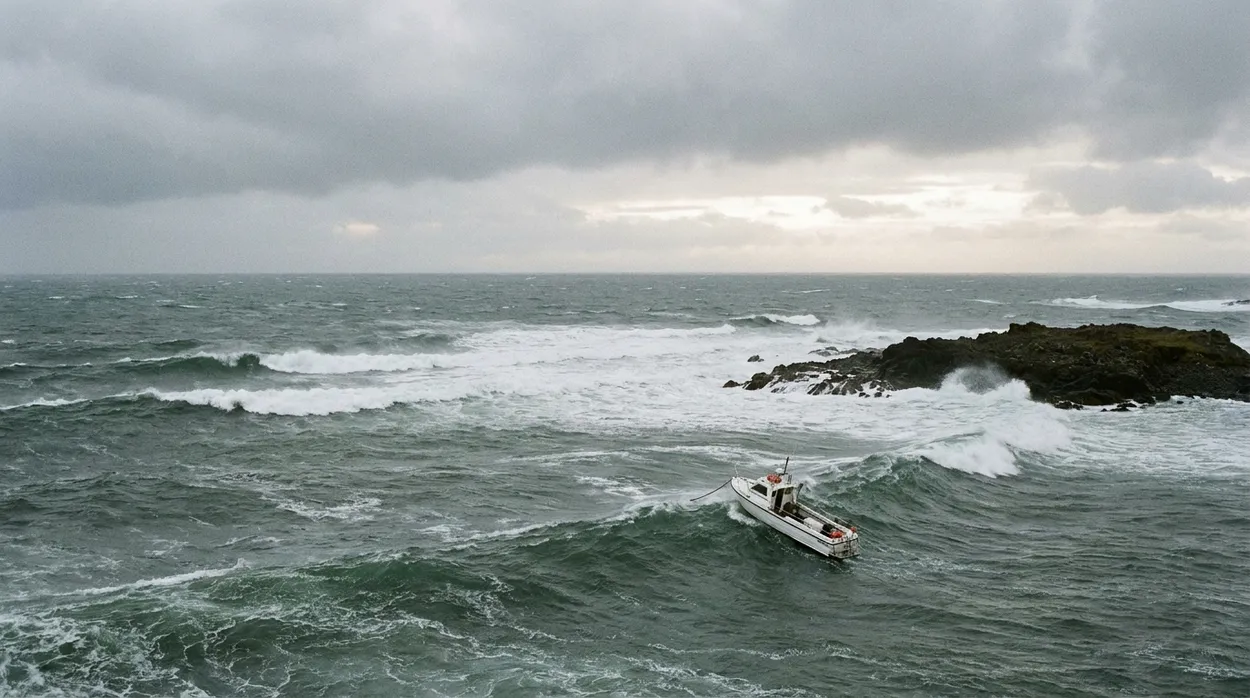
A typhoon doesn't have to hit Jeju to cancel your dive. What stops the boat is wave height, not rain. Korea's Meteorological Administration issues a High Seas Advisory when marine winds hold at 14 m/s or more for three hours, or when significant wave height is forecast to reach 3 m. A storm still sitting south of Okinawa can push that swell onto Seogwipo's south coast a day or two ahead of itself. If you're planning an August boat dive here, the wave forecast tells you far more than the storm track does.
A typhoon can shut down diving without coming near Jeju
The thing most visitors misread in typhoon season is swell. Korea's Meteorological Administration and the National Disaster Management Research Institute classify long-period waves of 8 seconds or more as swell. Unlike wind chop generated locally, swell carries energy from a distant storm and arrives regardless of what the weather is doing where it lands.
The problem is that it doesn't look dangerous. Swell reads as calm most of the time, then delivers a set of much larger waves every few minutes. That's why people standing on the harbour wall tell us the sea looks fine. For a diver this matters because every vulnerable moment in a dive happens at the surface: the giant stride off the back of the boat, the few minutes floating after your ascent waiting for pickup, the climb up the ladder with a tank on your back. Fifteen metres down it's quiet. Incidents happen in the last three metres.
When a typhoon tracks south of Jeju or through the East China Sea, the wave energy it generates propagates toward Korea's south coast and brings swell and high water onto the Jeju shoreline. That holds even when the forecast track misses the peninsula entirely. Typhoon Dolphin, moving north right now, is exactly that case.
Dolphin was forecast to reach a central pressure of 920 hPa and maximum sustained winds of 58 m/s, putting it in the "super strong" tier, the top category in the scale KMA began applying in 2026, which starts at 54 m/s. KMA said direct effects on the Korean peninsula were "difficult to state definitively at this stage," with a forecast error radius of 440 km for August 4. Even if the track slides toward southern Japan, a storm that size generates swell that reaches the water south of Jeju. The takeaway for anyone holding a dive booking: Jeju being absent from the forecast cone does not mean your dive is safe.
The numbers that decide whether the boat goes
The best predictor of a cancellation isn't typhoon coverage on the news, it's the KMA high seas advisory. The thresholds are public and they're specific.
| Status | Marine wind | Significant wave height | Dive boat |
|---|---|---|---|
| No advisory | Under 14 m/s | Under 3 m | Usually sails |
| High Seas Advisory (풍랑주의보) | 14 m/s sustained 3+ hours | 3 m or more | Subject to departure control, usually cancelled |
| High Seas Warning (풍랑경보) | 21 m/s sustained 3+ hours | 5 m or more | Cannot sail |
Once an advisory is in force, departure controls apply. The criteria vary by vessel type, length, gross tonnage and navigation area, and Korea's Ministry of Oceans and Fisheries can restrict departures whenever a marine weather advisory is issued or visibility is limited enough to compromise safe operation. That produces one consequence divers consistently get wrong.
Ferries running does not mean dive boats are running. A Seogwipo dive boat is a fraction of the size of the car ferries working Jeju's main ports. Because departure control thresholds scale with tonnage and length, the same sea state that a large ferry handles routinely will keep small craft tied up. And clearing the legal threshold isn't the end of it, the skipper and instructor still make their own call. Being permitted to sail and being right to take guests out are two different questions.
This summer gives a sense of the scale. On 14 July 2026 a nationwide high seas advisory put 42 sea routes under control, and two days before that a strong wind advisory on Jeju cancelled or delayed roughly 130 flights at Jeju Airport. Neither event involved a typhoon making landfall. Wind and waves alone did it.
The sea recovers slower than the sky
The morning after a typhoon clears, the sky is absurdly beautiful. Post-typhoon clarity is famous here. So anyone holding a booking for that day assumes it's on. In practice that's the trickiest day of the lot.
Two reasons. First, swell outlasts wind. Once the storm's winds have moved away, the long-period waves those winds built keep rolling in. Blue sky with a 3 m sea is an ordinary combination in August. Second, visibility. Big waves lift sand and sediment off the bottom and hold it in suspension. The surface can settle while the water column stays milky for days.
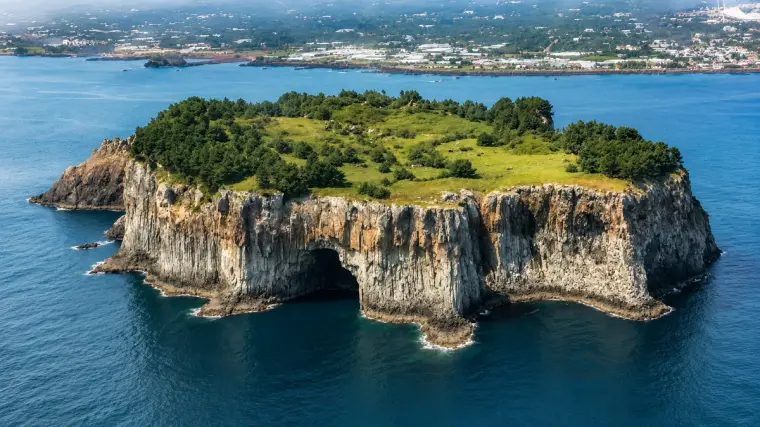
How fast it clears depends on the storm's strength and track and on the bottom composition at each site. Sandy sites stay stirred up longer; rock and boulder sites come back sooner. It isn't the kind of thing anyone can promise a number for, which is why asking your instructor on the day is the only accurate method. Beomseom and the other Seogwipo sites have one useful feature here: the islands themselves act as breakwaters, so depending on wind direction one face can stay workable while the exposed side is unusable. On a strong southerly, the north side may still be diveable. That's a same-day judgement, though, nobody can confirm it the night before.
The practical version: two days after a typhoon beats one day after.
How to build a dive trip that survives typhoon season
None of this is a reason to skip August and September. Water temperature peaks now and visibility is among the best of the year. It just changes how you structure the trip.
Build in a buffer day. One dive day inside a three-day trip leaves you with nothing when that day blows out. Four days with two possible dive days absorbs a storm without wrecking the trip.
Put the diving early. Booked on day one, a cancelled dive can move to day two or three. Booked on the last day, it has nowhere to go. Most people plan sightseeing first and save diving for the end, in typhoon season, do the opposite.
Watch the right page. The KMA short-term marine forecast for the sea south of Jeju is far more useful than typhoon headlines. If you're worried about flights, the aviation weather office's flight impact information is worth a look too. Jeju is an island that strands people on wind alone, no typhoon required.
Ask about weather cancellation policy before you book. Whether a weather cancellation gets rescheduled or refunded varies between operators. In typhoon season it's worth settling that question before you pay rather than after.
What 2026 looks like
KMA's annual climate outlook put the number of typhoons affecting Korea this summer at around the long-term normal of 2.5. By count, an unremarkable year. The same outlook, though, expected sea surface temperatures around Korea to run above normal from June through August.
Warm water is what lets a typhoon hold its intensity. An average number of storms can still mean individually stronger ones arriving, and that condition sits behind Dolphin reaching the super-strong tier. The same warming is changing what divers see underwater at Jeju typhoons are that shift showing up above the surface instead of below it.
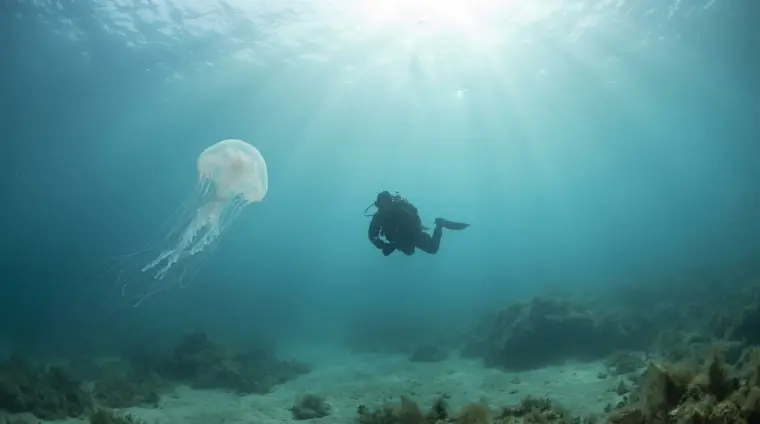
One other August variable worth checking alongside the weather: jellyfish. We've covered this season's situation and what to do about it separately.
The short version
In typhoon season, watch significant wave height rather than the storm's position. Past 3 m an advisory goes up and small boats get grounded first. The real window of disruption runs from roughly two days before a storm to two days after it passes, and a clear sky is not evidence the sea has recovered. Leave a buffer day and put your diving early in the trip, and your odds of getting good water in Seogwipo go up sharply, typhoon season or not.
If you've got dates in mind and you're unsure, tell us when you're coming and we'll look at the forecast for the sea south of Jeju with you and suggest which day to hold for diving.
FAQ
Can my Jeju dive be cancelled even if the typhoon passes toward Japan?
Yes. Swell carries energy from the storm across open ocean, so high waves reach the water south of Jeju even when the track misses the peninsula. Because it arrives as long-period waves of 8 seconds or more, the sea looks calm from the harbour and then produces a large set every few minutes. Once significant wave height passes 3 m a high seas advisory is issued and small vessels are the first subject to departure control.
Can I dive the day right after a typhoon passes?
The sky clears well before the sea does. Swell outlasts the storm's winds by days, and big waves lift sediment off the bottom, so visibility can stay poor even after the surface settles. Recovery depends on the storm's strength and on whether a site has a sand or rock bottom, so your instructor's call on the day is the only reliable answer. If your schedule allows it, two days after a typhoon is a better bet than one.
If ferries are running, will the dive boat run?
Not necessarily. Departure control thresholds are applied according to vessel type, length, gross tonnage and navigation area, so it's common for large ferries to sail in conditions that keep small dive boats in port. Clearing the legal threshold is also not the final word, the skipper and instructor decide separately whether to take guests out.
Do I get a refund or a reschedule if weather cancels the dive?
Policies differ between operators, some move you to another day, others have set refund terms. In typhoon season it's worth confirming this before you pay rather than assuming. Get in touch and we'll explain how we handle it before you book.
Is August or September safer for typhoons?
Both months sit inside typhoon season, so neither is reliably safer. KMA forecast the number of typhoons affecting Korea in summer 2026 at around the normal 2.5, but that's a whole-season figure and can't be applied to a specific date. Rather than choosing a month, you'll get more out of building a buffer day into the trip and scheduling your diving early in it.
About the author
Related Posts